


UK tech directors often face a costly problem: a local power outage can disrupt VPN access and lock out CRM systems for four hours. When power returns, teams need to verify transaction data, pushing operations into the weekend. While cloud migration and software scalability are prioritised, power reliability is overlooked, leading to increasing costs.
According to Utility Bidder, the UK had already faced 14,475 unexpected power outages in 2025. This averages about 2,000 outages each month. It’s estimated that the total for the year will continue to increase. For companies that link local servers to cloud platforms, a local outage can trigger a severe system breakdown rather than a tiny inconvenience.
At Xyber Technologies, we offer tech solutions aligned with the unique needs of each startup, ensuring optimal technological support and guidance. Let’s explore the gaps in your digital transformation strategy and how you can audit and build redundancies.
The Gap Nobody Talks About
When executives discuss digital transformation, the primary focus centers on cloud technology. Cloud platforms offer seamless scalability, operational flexibility, and remote accessibility. But what about the physical infrastructure remaining on-premises?
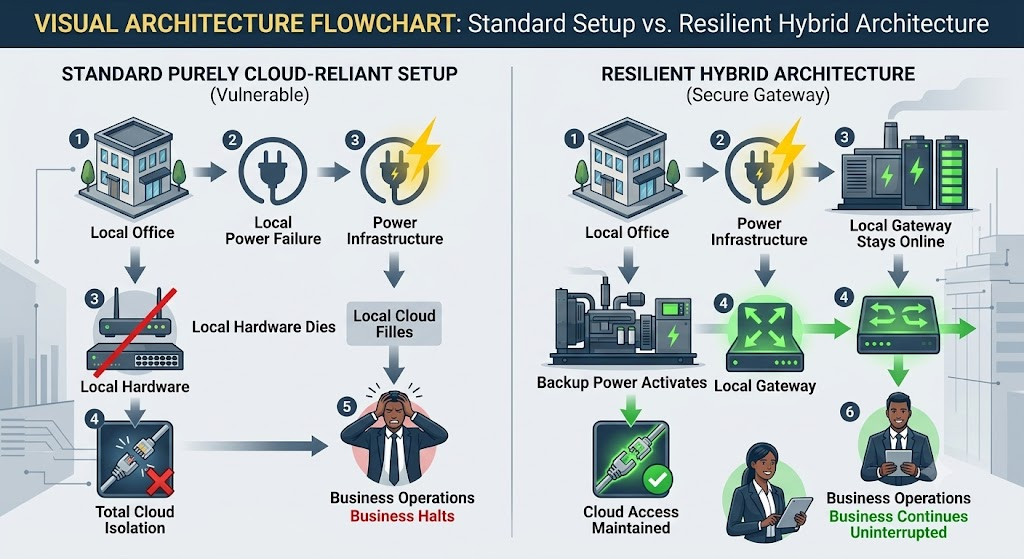
Hardware such as local routers, network switches, login servers, and edge computing equipment remains crucial. They are the entry points to all your cloud services. If the power goes out at the main office or a local center, these physical devices are the first to stop working. Once they go down, access to cloud-hosted assets is completely severed.
1. Local Networks Fall First
If a team cannot connect to a cloud app, the root cause is often the on-site network architecture. This network uses physical equipment in your building. If the power goes out, your connection is lost. It does not matter if data is stored in a resilient, remote data center. If your office router fails, your team is entirely isolated.
2. Hybrid Servers Carry Real Risk
A lot of companies use a mix of local and cloud systems. Data is processed locally first, then sent to the cloud. If the power goes out while data is being transferred, it can do more than just stop things. It can actually ruin the whole data transfer. Fixing problems caused by an incomplete data transfer takes a lot of time, is tricky, and costs a lot of money.
3. Edge Computing Raises the Stakes
When businesses use edge computing, they face an even bigger risk. Edge systems are built to do important tasks right there, on the spot, without delay. If the power is cut while these tasks are happening, the whole system can break down because it cannot finish what it started. The cloud can’t fix this kind of problem.
Audit Your Physical Dependencies Now
Before expanding your cloud services, map the physical dependencies supporting your digital workflows. Find out what local hardware is really important, what tasks need constant power, and which teams cannot use their tools if something goes wrong.
To see how it’s done, look at this guide. It explains the key steps for an IT Infrastructure Audit Checklist, giving you a good starting point.
Ask yourself this simple question: If the power at this location goes out for two hours, which digital tasks will completely stop? You’ll likely discover more physical needs than you realise. Then, compare these to your current business continuity strategy. If the plan doesn’t include what happens when local power fails, it’s not good enough.
Building Physical Redundancy
A 2026 Oxford Economics report predicts that the UK’s data centers will use over five times as much electricity by 2030. This could reach 26.2 TWh, which is 8.8% of all electricity used in the UK. This shows how much our digital world depends on physical power. Companies that think the power grid can handle this without issues are taking a big gamble.
Having backup power works differently depending on the operation size. A firm with just one location might need a backup power system for its essential computer equipment. A company with multiple locations needs backup power at every point that connects to the internet.
Relying on established power engineering specialists such as www.wbpsltd.co.uk lets businesses maintain uninterrupted site operations during widespread utility shortages. Taking this precaution ensures that the physical gateway to cloud systems remains open under any circumstances.
Renting emergency generators, keeping systems constantly powered, and performing regular maintenance are the physical actions required to support backup systems in the cloud. If you only have one of these, your plan for staying online isn’t complete.
Conclusion
When digitally transforming a business, never overlook power outages. Recent events in the UK highlight the risks of relying solely on the national grid. To shield infrastructure, audit local power sources and establish strong backup systems. Contact us at Xyber Technologies to create a comprehensive plan.

